![[personal profile]](https://www.dreamwidth.org/img/silk/identity/user.png) jadinerhine
jadinerhineMuch like my Sapphire post, this is yet another old Tumblr post that I am bringing over here for archival purposes. Also because, as a Livejournal truther, I always prefer LJ posts even literal decades after the fact, and since DW is LJ but nicer...why not lol.
Much like my Sapphire post as well, this one has no edits. It is as of this writing a 6-yr-old post. I looked it over and I don't think I would change anything but I'm also running on fumes these days, so it's likely that there is something to be updated, I've just missed it. That said, there are some edits: the translation itself. Rather, I didn't do a re-translation like I have wanted to do, make sure it's all still correct (as correct as a fan translation can be), but instead I went back and fixed some words and grammar issues. Looking back, I was slightly afraid of messing this up: even when trying to make sure the translation is understood by everyone and not aim for "literal," I still went a little literal lol. So this is now version 2.0 of the translation wording itself. I think it works better, even if I mourn the loss of "Earthian" for 地球語 ("chikyuu-go," literal: earth language.) I mean, I think it's fine, but something about it bugged me visually. "Terran" fits the sci-fi mold of Macross better.
Once again, no edits to the post contents itself but some edits to the translation wording, and a transcript of the translation. The "font" in the first translation isn't really a font, it's my hand-writing. Since the original was, you know, handwritten notes, I thought the translation should also have that same touch.
Oh, and for the record, I didn't pull anything out of my butt for the linguistics stuff, for I have a degree in the thing. Not that having a degree necessarily means I'm an expert (I'm not, and plenty of people have degrees while appearing to have slept in class all four-five years)--and not that you may not believe me (after all, pictures or not real)--but hopefully how I translated and how I explained things proves it.
Additionally, here is a free Zentradi font download, and the same one on a newer site, all created by super fan Ranko Asai (あさいらんこ). Enjoy!
Now, without further ado...
++++++++++++++++++++++++++
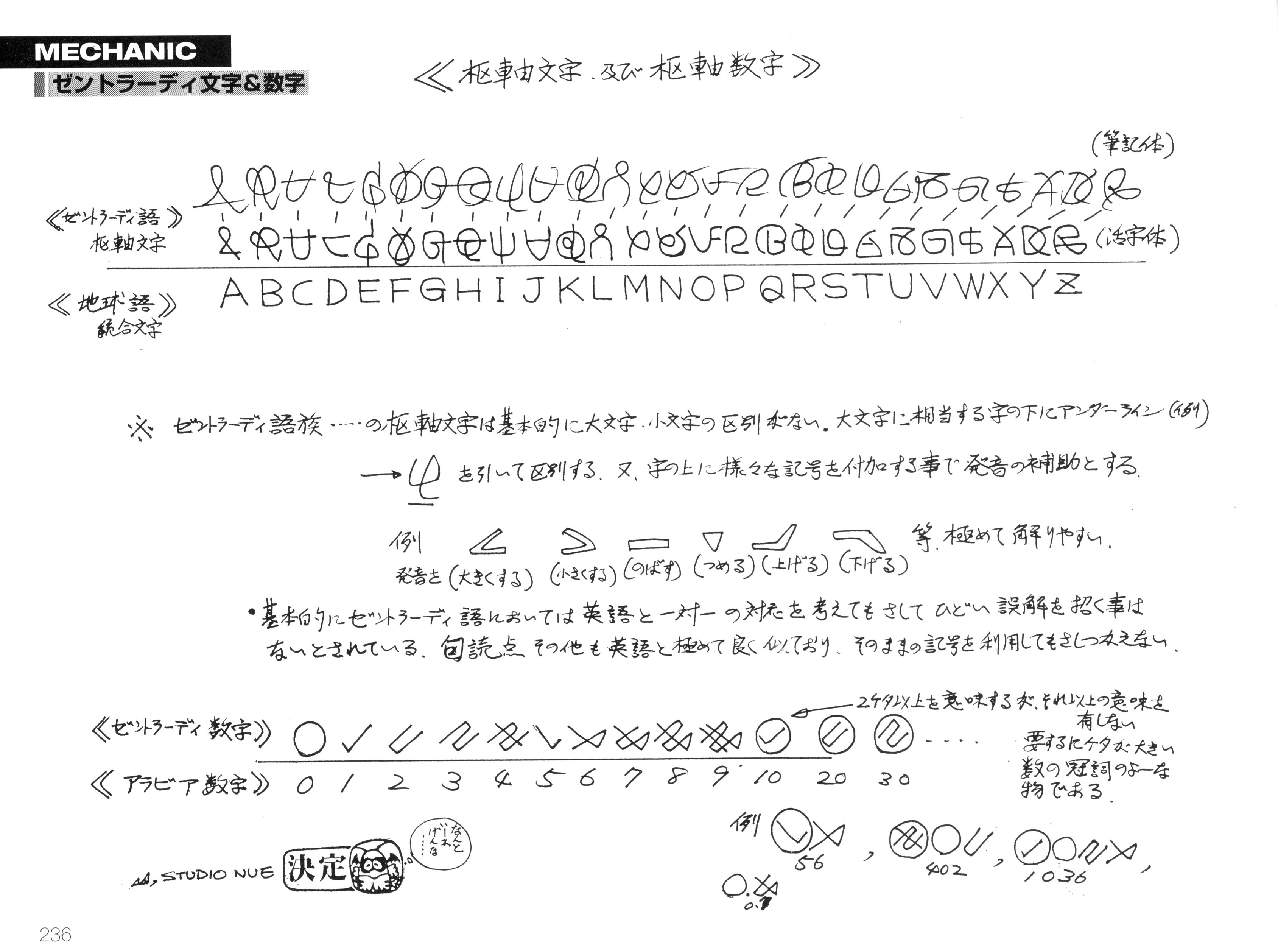
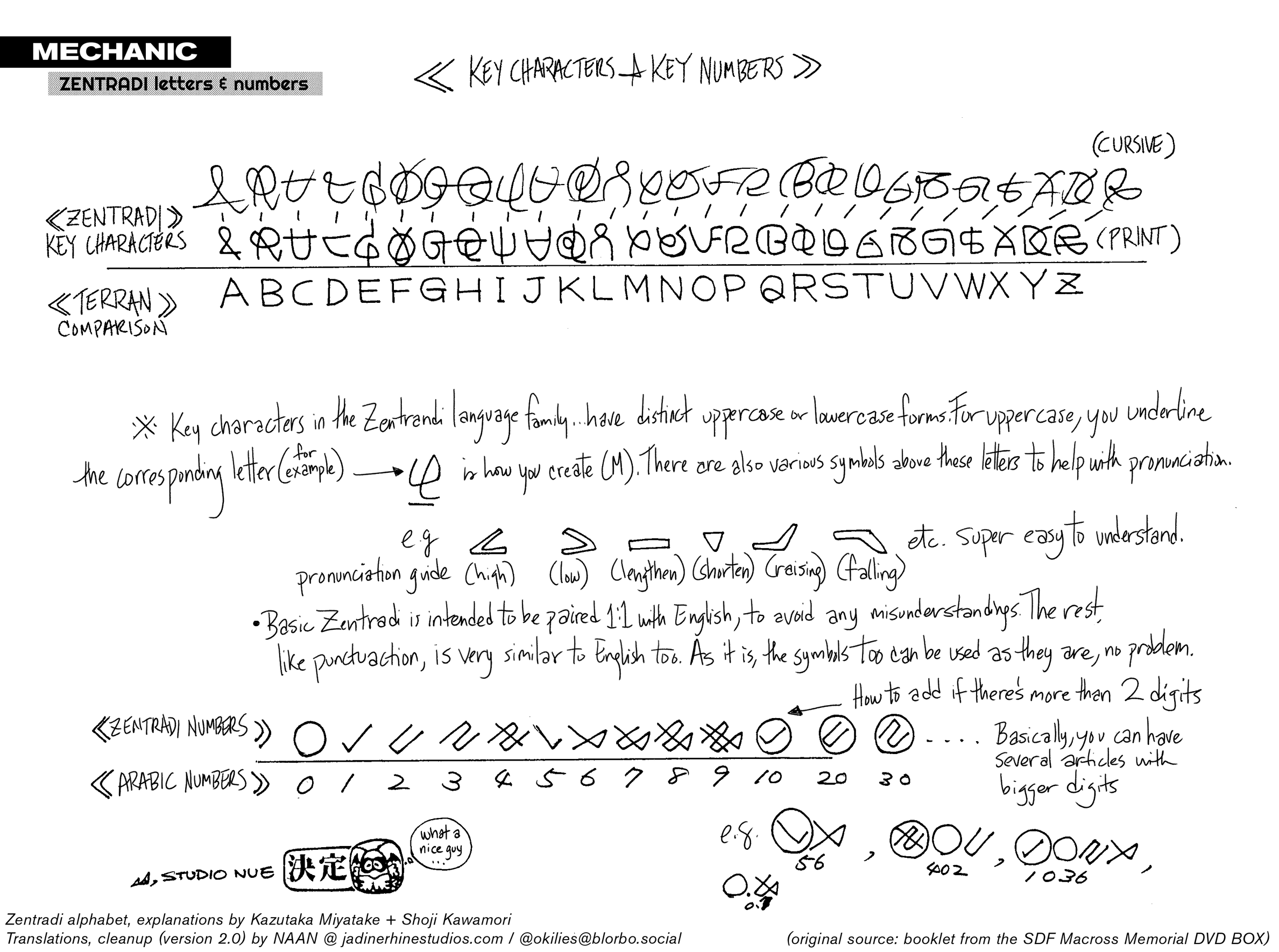
Here is the transcription of the translation:
MECHANIC
ZENTRADI letters & numbers
KEY CHARACTERS + KEY NUMBERS
There are three pictorial charts here. The first two are of the Zentradi writing, shown in cursive writing and print writing. The one below these two is the Latin alphabet, placed there for comparison. To the left of these charts are "Zentradi - Key Characters" and "Terran - Comparison"
*Key characters in the Zentradi language family...have distinct uppercase or lowercase forms. For uppercase, you underline the corresponding letter (for example) -- the Zentradi glyph for M, with a line underneath it. There are also various symbols above these letters to help with pronunciation.
For example, pronunciation guide -- then follows symbols for the following tones: high, low, lengthen, shorten, raising, falling, etc.
Super easy to understand.
*Basic Zentradi is intended to be paired 1:1 with English, to avoid any misunderstandings. The rest, like punctuation, is very similar to English too. As it is, the symbols too can be used as they are, no problem.
Then follows two more charts, this time for the numbers. One is the Zentradi numbers, represented here with slanted glyphs. The other, below it, are the Arabic numbers represented as such. There is a note next to these with an arrow: How to add if there's more than two digits. It shows how, in creating double digits, you circle the number.
Basically, you can have several articles with bigger digits.
Then an example follows of Zentradi numbers, such as 56, 403 and 1036.
In the bottom left corner is a STUDIO NUE stamp, with its mascot encased in a bubble saying "What a nice guy..."
( "NAAN, why did you doubt that when this website that has the Zentradi Text Book also confirms it?" )Because I wanted to be very sure about it and I wanted to practice my skillz -- I wanted to challenge myself on translating the image above for more info!
To be honest, I had googled for the text book with no luck. It's not until I just now googled for the stamp kit for an image of said text book's cover from the ad for said stamp kit, that that dang old Macross World site pops up.

Also, both the series and the "Do You Remember Love" film gave indication that the Zentradi had their own language in terms of actual words and phrases (taarm, mizion, the famous yack deculture) I figured then, maybe this page from the Memorial DVD booklet had some answers to that part as well!
Anyway, point to this whole digression...It was good to see the site now confirm parts of my translation, as bad as it is probably (I'm only intermediate level in JP learnin'.) 1:1 English analogue, capitalization and numbers! NUMBERS ARE CHARACTERS, NOT ROMAN NUMERALS, WHAAAT. The way case sensitivity works in Zentran surprised me though! No lowercase or uppercase, but if you really want to do an uppercase, you just...underline. Okay? Whutta indecisive language XD
We should totally just wait til Macross 7 decides to instead use the circle for uppercase AND numbers and oh.
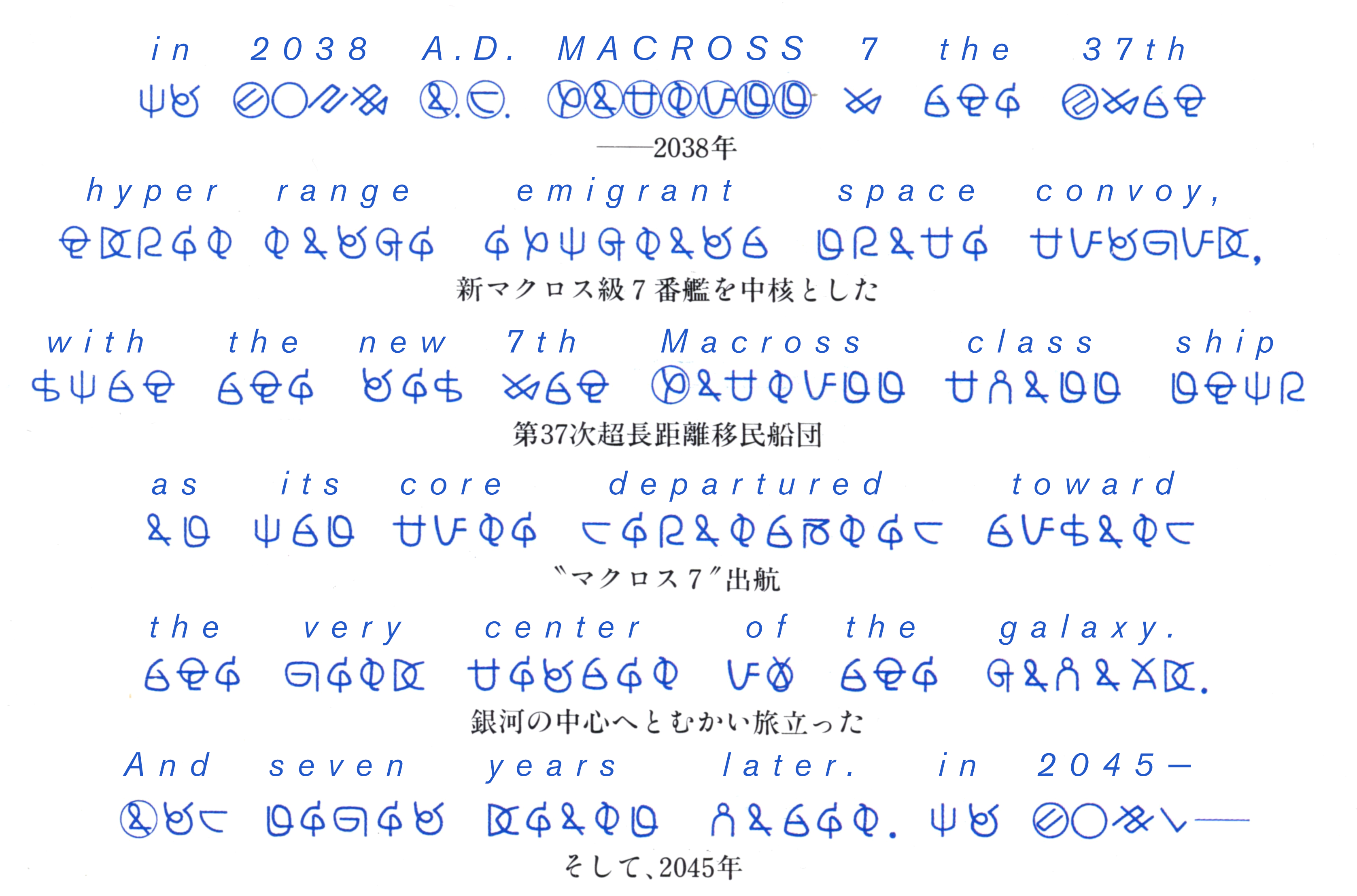
Here's the transcription of the translation:
in 2038 A.D. MACROSS 7 the 37th
hyper range emigrant space convoy,
with the new 7th Macross class ship
as its core departured toward
the very center of the galaxy.
And seven years later, in 2045--
But I dig the way numerals were considered as important enough to concentrate on, too. I mean, I can't think of a conlang that has syllabic characters that also went "huh...what about numbers, though?" That's pretty cool. And how you can form numbers with more than 2 digits.
And that pronunciation guide! HOLY CRAP, *PRONUNCIATION*???? My linguist senses tickled pink, because that meant skipping the translation temporarily and just go straight to tone! It's a thing in linguistics :D See Tone on Wikipedia, and "A Linguist's Introduction to Tone."
I'm serious, if there was one thing I didn't expect this darn thing to have, it's how to keep an eye on pronunciation. THE ZENTRADI DON'T EVEN SEEM TO INDICATE TONALITY IN THE FILM ALONE??? Maybe I need to listen to it again. But again, this is what's so good about this: thought! There was genuine thought put into something so...not important for a mainstream anime series to think about.
Even typing my thoughts about this makes me happy, because it would've been so understandable for this to be a throwaway thing in an anime show. Really. And it wasn't. They thought about minute details.
(But it's Macross, you say. Why wouldn't a show with culture as a theme *not* do it?)

Backtracking to my bad translation comment -- the one thing I realized in my initial drafts was that I decided to translate from a person's handwriting. HANDWRITING. Anyone will tell you those are sometimes the hardest to decipher in any language. (Those who say no are lying) And uh, yeah. It was a wild ride. Up until the end, there were still 5 kanji that I had absolutely either no clue what they were or I found 10 different versions that could be the actual kanji in question. Those goshdarn strokes! IN THAT CURSIVE/PRINT HYBRID FORM.
But thankfully, one website, to whom I will always sacrifice my firstborn in different dimensions, had kanji listed in normal text and in that hybrid handwriting example. I WAS SAVED, THANK YOU YAMASA. Such a fantastic resource!!
(it's down right now, and I hope it comes back up, because seriously, it's such a great resource. I have 4 kanji dictionaries and none of them have that style of handwriting. It saved my bacon.)
As you may have noticed, no answers as to how or where the actual words came from or how grammar worked in Zentran. That's my fine -- always aim big and be only mildly disappointed with the few answers you get is my motto. In this case, I wasn't even disappointed. Just happier! And even if I got parts of this translation wrong (even now, some of those English sentences still sound wonky to me), I was proud that I was able to get this far and learn more in the process about how Japanese works.
Plus, seeing how an anime conlang was formed is ACES.

ADDENDUM HERE:
From pterobat:
I read in translations of Macross Chronicle that Zentradi was a tonal language, but you’re right that we don’t see evidence. I think the worldbuilding of Macross is just thin in general, but when they try, the results are really cool.
From jadinerhine in response:
Oooh, that’s curious to know! I have noticed that there’s a huge usage of the letters A, D, and I but nothing really concrete to determine why. I could argue that ultimately Japanese syllable formation played a part, as conlangers’ native tongue influence both consciously and unconsciously, which maybe lends to the notion that it’s a tonal language…but no evidence for that either!
(And yeah, I agree. When they try, we get something cool :D)


